Demo 1 · Chat
Read the unreadable
In 10 minutesA one-page, plain-English brief of an 80-page survey of prompting research — the kind of paper everyone cites and almost nobody reads end-to-end. Then you'll push back on Claude's first answer, because that's the real skill. Bonus: this particular brief makes you better at the other two demos.
Quick check: the bottom-left of Claude Desktop should say University of Chicago Enterprise — yes, at TTIC. If it doesn't, do Sign in once first.
Download the survey (PDF, 3 MB)
Steps
- Click the button above. It saves to your Downloads folder. (If the PDF opens in your browser instead, click the download icon at the top-right of the viewer, then click Back.)
- In Claude Desktop, click New at the top of the sidebar to start a fresh chat. In the message box, make sure the little toggle reads Chat (not Cowork) — click Chat if it doesn't.
-
Click the + button, choose Add files or photos, and pick
the-prompt-report.pdf— or just drag the file into the window.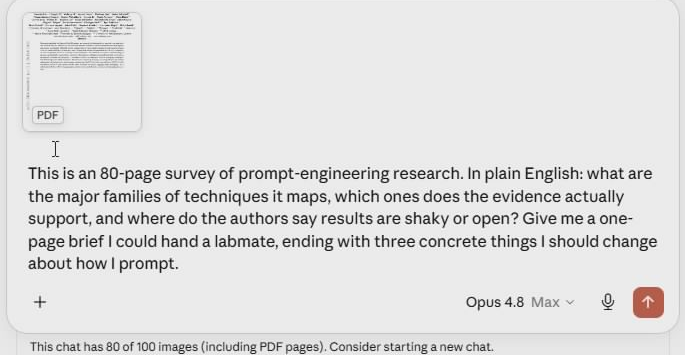
The 80-page survey attached and the prompt ready — hit Enter to send.
-
Paste this prompt and hit Enter:
This is an 80-page survey of prompt-engineering research. In plain English: what are the major families of techniques it maps, which ones does the evidence actually support, and where do the authors say results are shaky or open? Give me a one-page brief I could hand a labmate, ending with three concrete things I should change about how I prompt.
Give it a couple of minutes — Claude reads all 80 pages first, then the brief streams in as it writes, so a slow start is normal. About two minutes for a paper that would eat an afternoon.
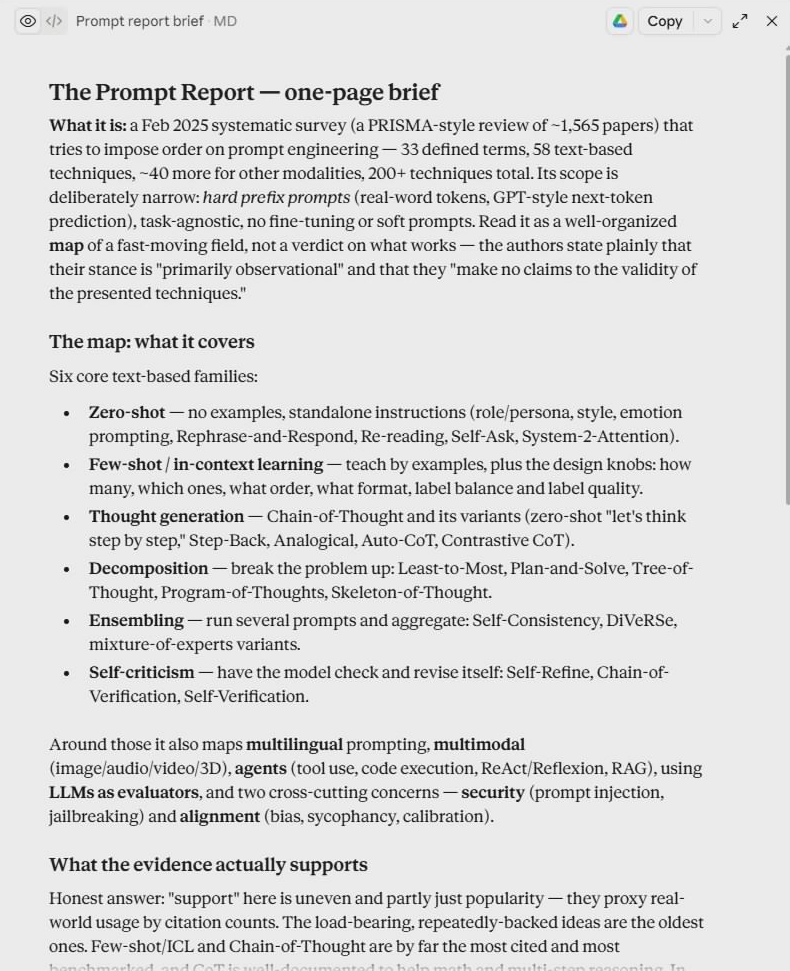
Claude's one-page brief — the six technique families, what the evidence actually supports, and where it's shaky. Here it opened as a tidy document alongside the chat.
The brief is yours to keep — click the Copy button at the top of the brief and paste it straight into your notes or an email to your group.
Don't take the first answer — push back
This is the part most people skip, and it's where the value is. You bring the judgment; Claude does the reading. Challenge it:
Don't summarize — cite. Which three findings in this survey have the strongest empirical backing? Quote each claim straight from the paper with its section number so I can check it myself.
Notice what you just did: you didn't accept a tidy summary on faith, you made Claude show its work against the source. Do that with anything that matters — especially anything you might repeat in a talk or cite in a paper.
Yes, this is allowed — it's the University of Chicago enterprise workspace (that's what the corner check confirmed), and the file never leaves it. If your own document has regulated data (student records, health information), check UChicago's AI guidance first.
Your turn
Attach the worst PDF in your pile — the 60-page survey of a field you're entering, the grant solicitation, the dense paper from the adjacent area you've been avoiding — and adapt the prompt:
This is [what the document is]. In plain English: [your two or three real questions]. Give me [the output you could actually use tomorrow].
Then push back the same way — make it quote the source with section numbers, or redo the part you don't trust.
When you'd rather hand off the whole task and get back a finished file, that's a Delegate — next page.
Next: 2 · Cowork — abstracts to spreadsheet
Survey: Schulhoff et al., "The Prompt Report: A Systematic Survey of Prompt Engineering Techniques" (arXiv:2406.06608), CC-BY-4.0.